
For kids in the United States, the tariff imposed by the Donald Trump administration on countries like China may no longer be a child's play, as toy prices are predicted to touch record highs this Christmas season. However, for India's toy export industry, which was ready to take giant strides in the sector by bagging heavy orders from the US retail giants like Walmart, Amazon, and Target Corporation, gaining from the China-Plus-One policy, the US tariffs came as a heavy jolt.

The MiG-21 episode demonstrates that procurement is always strategic.
Choices about what aircraft to acquire, who builds them, who supplies the spares, who trains the pilots and technicians are decisions with political consequences lasting for decades.
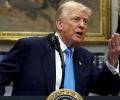
Industry leaders urge India to pursue diplomatic talks with the US, strengthen manufacturing, and consider China ties to gain leverage against tariff pressures.
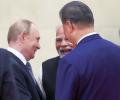
Navarro's remarks came after the public display of bonhomie by the three leaders on the sidelines of the Shanghai Cooperation Organisation (SCO) summit in Tianjin on Monday.
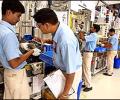
While the special economic zones have seen several labour laws being by-passed within their geographical confines, that is not the case with the NMP.

'While the President has been critical of India, he has gone out of his way to compliment PM Modi. They have an incredible relationship.'

India is aiming to become a global hub for green hydrogen exports, eyeing nearly 10 per cent of the worldwide demand by 2030, Union Minister Shripad Yesso Naik said on Tuesday. Addressing FICCI Green Hydrogen Summit 2025, the minister said 8.62 lakh tonne annual hydrogen production capacity has been awarded to 19 companies.
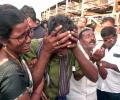
'This tragedy will not be the last -- you shall witness another tomorrow, perhaps another the day after, and increasingly more.'
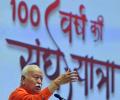
'Whatever is necessary for life and is not made in your country, we will import it from outside.'

Former White House trade advisor Peter Navarro accuses India of being an 'oil money laundromat' for Russia, alleging that India's oil purchases are funding Putin's war in Ukraine. The accusations come amid existing trade tensions and tariffs imposed by the US.

The textile and apparel sector is India's second-largest employment provider, after agriculture, and it is now caught in a wave of uncertainty following the Donald Trump administration's tariff policy.

New lower GST rates kicked in from Monday, resulting in a slashing of prices of as many as 375 items ranging from toothpaste and shampoo to cars and television sets, a move seen as an attempt to boost consumption to cushion an economy facing tariff headwinds. Tax rates of 5, 12, 18, and 28 per cent have been clubbed into two rates of 5 per cent and 18 per cent, resulting in a reduced price of 99 per cent of daily use items.
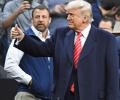
Trump is confident the US will eventually emerge the winner from whatever turmoil his policies cause, notes T T Ram Mohan.

Services cannot create enough jobs that will match the skill sets of the bulk of the work force, says Nirvikar Singh.
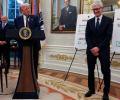
'India has intentionally taken advantage of the war in Ukraine to dramatically increase its purchases of Russian crude, when there are roughly 40 major crude providers that could satisfy Indian demand.'

If India caves in to US pressure as Trump hopes it will, he will further try to blackmail it into submission, points out Ramesh Menon.
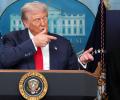
In trade negotiations, as in chess, sometimes you need to accept a temporary disadvantage to secure a better long-term position, points out Sonal Varma, chief economist (India and Asia ex-Japan) at Nomura.

The Indian government outlines its futuristic defence programme, Sudarshan Chakra Mission, focusing on indigenous development, predictive technologies, and targeted counter-action systems to enhance national security.

India-US relations, like Rome, were not built in a day, nor can they be demolished in a day.
All said and done, when the new global order emerges, India can only remain with the democracies, asserts Ambassador T P Sreenivasan.
NIMZ is conceptualised as integrated industrial townships with all-important elements to help the growth of infrastructure, clean and energy efficient technology, simplified business regulations and the necessary social and institutional infrastructure.

Indian economy grew by 7.8 per cent in April-June -- the highest in five quarters -- before the disruptive US tariffs were imposed.

President Droupadi Murmu addressed the nation on the eve of Independence Day, praising the response to terrorism, highlighting achievements in defense self-reliance, and emphasizing unity and progress.
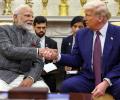
A US lawmaker and former officials warn that President Trump's policies are damaging the strategic partnership between the United States and India, potentially driving India closer to China and Russia.

In a significant policy announcement from the Oval Office, President Donald Trump has declared a 25 per cent tariff on all imported vehicles entering the United States, a move he described as "very exciting" for domestic manufacturing. The tariffs, set to take effect on April 2, will impact nearly half of all vehicles sold in the United States, including American brands assembled overseas.

'The Indian developer community is one of the most vibrant communities.' 'Indian builders are incredibly passionate, curious, and excited to embrace new technologies.'
India needs manufacturing sector growth for a variety of reasons.

"It will be ensured that such agreements (free trade agreements) do not have a detrimental effect on domestic manufacturing in India," according to the National Manufacturing Policy (NMP), cleared by the Union Cabinet on October 25.

'Geopolitically and diplomatically it's a very difficult situation for India.'
"The report of the committee will form basis for the country's manufacturing policy," National Manufacturing Competitiveness Council Chairman V Krishnamurthy, who is also member of the panel, told reporters. Prime Minister Manmohan Singh had announced setting up of the high-level committee in 2006. Its mandate included looking into macro-economic issues stifling the growth and competitiveness of the manufacturing sector.
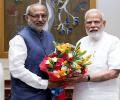
By naming a sworn swayamsevak for vice president, the Modi-Shah duo have sent out a clear and positive message to Nagpur, where the RSS headquarters is located, explains N Sathiya Moorthy.

The growing rift between MSIL and rival automakers has complicated the government's efforts to finalise the CAFE norms.
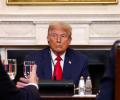
United States President Donald Trump announced a 50 per cent tariff on imports from Brazil, starting August 1, and called the trial of former Brazilian President Jair Bolsonaro a 'witch hunt', adding that the 'trial should not take place'.

Simplifying GST rates, removing exemptions, easing disputes, and speeding up refunds can boost investment in India and offer the best reply to Trump's tariffs, observes V S Krishnan, former member, Central Board of Indirect Taxes and Customs.

Pixxel has raised $95 million in funding and with the company's commercial Firefly satellites up in orbit selling data globally 'we know and seen what it takes to make this business work.'
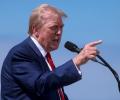
Essential and strategic items such as pharmaceuticals, semiconductors, copper, and energy products like oil, gas, coal and LNG are exempted from the 27 per cent import duty announced by the US on Wednesday, according to think tank GTRI.
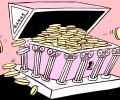
In a double-dose bid to boost growth and employment prospects, the Union Cabinet on Tuesday approved a Rs 2.07 trillion outlay for a research development and innovation (RDI) Scheme to fund private sector innovations, and an employment-linked incentive (ELI) to create over 35 million new jobs over the next two years.

'In 2024-25, 1 million units of cars were transported via railways. This is 20.6 per cent of India's total car production of over 5 million.'

US President Donald Trump's plan to sign an executive order to cut prescription drug prices by 30-80 per cent could lead to a global price adjustment with pharma firms pushing lower-cost countries like India to raise prices, according to the economic think tank GTRI. The US move could push prices in lower-cost countries like India as manufacturers would seek to recover losses and R&D costs from these nations.

Several multinational medical device makers are focusing on deepening their presence in India by expanding their local manufacturing footprint and research capabilities, a move that can catapult India into a strategic hub for the medical technology (medtech) industry. Among those increasing their reach in the country are Siemens Healthineers and Philips, signalling a broader shift from India being only a sales destination to becoming a global production and innovation base.

Union Minister Nitin Gadkari voiced concerns about increasing poverty and wealth concentration, advocating for wealth decentralization and job creation in rural areas. He also highlighted the need for balanced sectoral contributions to GDP and discussed infrastructure development initiatives.
 © 2026 Rediff.com - Advertise with us - Disclaimer - Privacy Policy - Sitemap - Feedback - About us - Terms of use - Grievances